



Every Managed Service Provider (MSP) claims to offer “security.”
Very few can actually prove it.
As cyber threats increase and cyber insurance carriers, regulators, and customers demand stronger controls, many IT providers have quietly rebranded themselves as security-focused—without changing how they truly operate.
For business owners, that creates serious risk.
This guide explains how to spot a fake security provider, the exact questions to ask when vetting an MSP, and how to separate real security partners from providers relying on buzzwords and basic tools.
The Problem: “Security” Has Become a Marketing Term
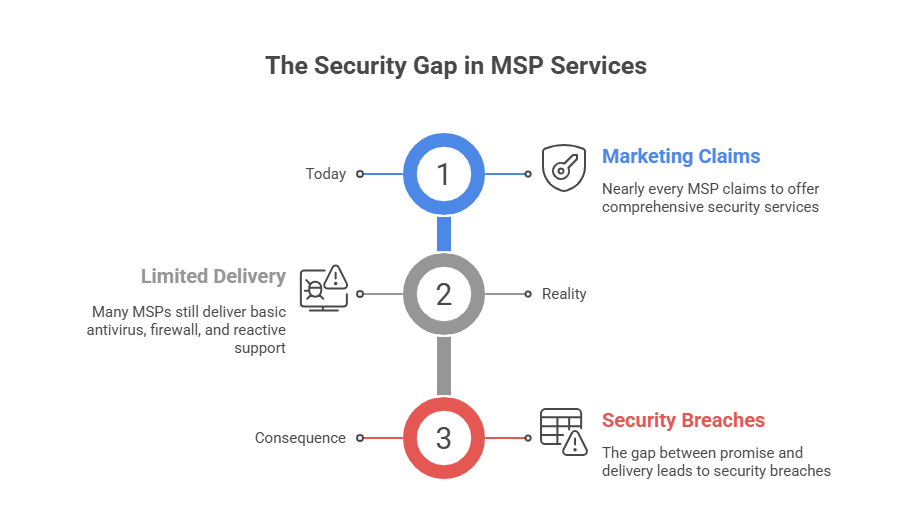
Today, nearly every MSP says they provide:
- Cybersecurity
- Compliance
- Risk management
- 24/7 protection
In reality, many still deliver:
- Antivirus and firewall management
- Occasional patching
- Reactive support
- No real security ownership
That gap between what is promised and what is delivered is where breaches occur.
Why This Matters More Than Ever
Choosing the wrong MSP is no longer just an IT decision. It is a business risk.
A weak or fake security provider can expose your organization to:
- Ransomware and extended downtime
- Data breaches
- Compliance failures
- Denied cyber insurance claims
- Contractual and reputational damage
If your MSP cannot clearly explain how they protect your business, they likely are not doing it well.
What a Real Security Provider Actually Does
A legitimate security-focused MSP:
- Manages risk, not just tools
- Designs security around business operations
- Actively monitors, tests, and improves defenses
- Explains tradeoffs and limitations honestly
- Takes accountability when incidents occur
Anything less is security theater.
Questions to Vet an MSP’s Security Claims
Use these questions before signing a contract, or to evaluate your current provider.
1. What security outcomes are you accountable for?
Red flag: “We install best-in-class tools.”
Look for ownership of risk reduction, uptime, response time, and recovery.
2. How do you detect and respond to threats?
Red flag: Vague references to “monitoring.”
Look for documented detection, escalation, response, and recovery processes.
3. Who is actively watching our environment and when?
Red flag: Alerts reviewed only during business hours.
Look for 24/7 monitoring with defined response SLAs.
4. How do you validate that security controls work?
Red flag: “Our tools handle that.”
Look for regular testing and verification.
5. What happens when something gets through?
Red flag: “That’s unlikely.”
Look for a clear incident response and recovery plan.
6. How do you reduce business risk, not just IT risk?
Red flag: Tool-only answers.
Look for discussion of downtime, revenue impact, and compliance.
7. What security responsibilities still fall on us?
Red flag: “We handle everything.”
Look for transparency around shared responsibility.
8. How does security evolve as our business changes?
Red flag: Fixed, one-size-fits-all packages.
Look for ongoing risk reviews and adjustments.
9. What security metrics do you report to leadership?
Red flag: No reporting or only technical dashboards.
Look for business-level risk reporting.
10. How do you support audits and compliance requests?
Red flag: “We help if something comes up.”
Look for proactive documentation and readiness.
Common Signs of a Fake Security Provider
- Heavy focus on tools, light on process
- No defined incident response ownership
- Security treated as an add-on
- No regular risk reviews
- Blame shifted after incidents
If your MSP struggles with the questions above, they are not a true security partner.
Why Businesses Struggle to Vet MSPs
Most business owners are forced to:
- Trust technical language they do not use daily
- Compare similar-sounding vendor claims
- Assume “no incidents” equals “secure”
Unfortunately, a lack of incidents does not mean strong security.
The right questions reveal the truth quickly.
Why Uprite Takes a Different Approach
At Upright, security is not a marketing term. It is an operational discipline.
What Sets Uprite Apart
- Security designed around business risk
- Clear ownership of detection, response, and recovery
- Continuous testing and improvement
- Transparent communication with leadership
- Systems designed to perform on the worst day, not just the best
We help organizations make informed decisions because real security starts with clarity and accountability.

Stephen Sweeney, CEO of of Uprite.com, with 20+ years of experience brings tech and creativity together to make cybersecurity simple and IT support seamless. He’s on a mission to help businesses stay secure and ahead of the game!